Introduction
What Is the 3-3-3 Rule for Health? Health advice does not always have to be complicated. Sometimes, a simple routine can make healthy habits easier to remember and practice consistently.
So, what is the 3-3-3 rule for health? The answer depends on the context.
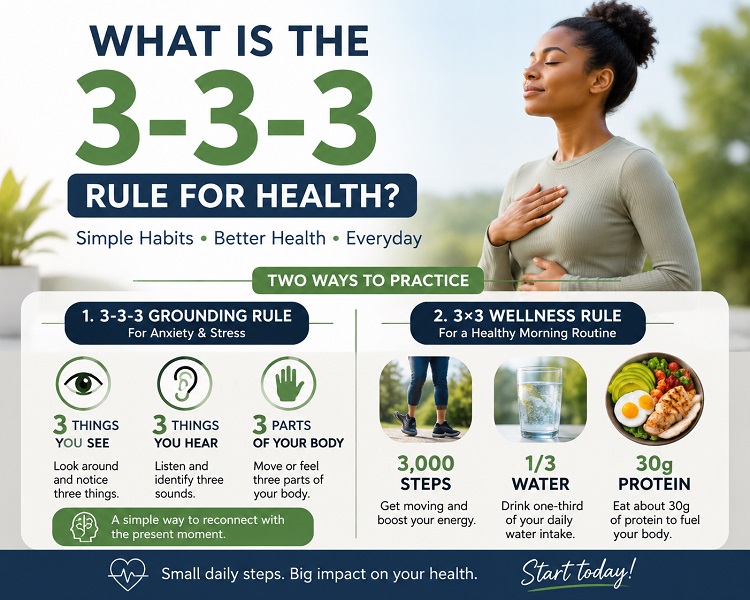
The most established use of the 3-3-3 rule is as a simple grounding technique for people experiencing anxiety or overwhelming thoughts. It encourages you to focus on three things you see, three things you hear, and three parts of your body that you can move or feel. The purpose is to shift your attention from distressing thoughts toward the present moment.
A separate wellness trend called the 3×3 rule encourages people to complete three healthy actions before noon, often described as 3,000 steps, one-third of their daily water intake, and 30 grams of protein. This is a newer social-media wellness concept rather than an official WHO health guideline.
Understanding this distinction is important because there is no single universally accepted medical “3-3-3 rule” for overall health.
What Is the 3-3-3 Rule for Health?
When people search for what is the 3-3-3 rule for health, they may be referring to either the anxiety grounding technique or the newer wellness routine.
The 3-3-3 rule for anxiety
The traditional 3-3-3 technique works like this:
- Name three things you can see.
- Identify three things you can hear.
- Move three parts of your body.
For example, if you suddenly feel overwhelmed, you could identify a chair, a window and a book. Then listen for three sounds, such as traffic, a fan and someone talking. Finally, move your fingers, shoulders and feet.
The exercise helps redirect your attention toward your immediate surroundings. Mental-health organizations and healthcare providers describe it as a practical grounding strategy for anxiety.
It is important, however, to understand that this is a coping technique, not a cure for an anxiety disorder.
The newer 3×3 wellness rule
The second meaning has become popular through wellness and social-media content. It generally involves completing three activities before noon:
| Goal | What it means |
|---|---|
| 3,000 steps | Walk or move enough to reach about 3,000 steps |
| 1/3 water | Drink roughly one-third of your daily fluid target |
| 30 g protein | Consume about 30 grams of protein, often at breakfast |
The idea is to start the day with movement, hydration and nutritious food.
However, the specific numbers are not universal medical requirements. Research and official health recommendations support regular physical activity, adequate hydration and balanced nutrition, but they do not require everyone to follow this exact 3×3 formula.
What Is the 3-3-3 Rule for Nutrition?
If you are asking what is the 3-3-3 rule for nutrition, it is important not to confuse several different wellness trends.
The newer 3×3 approach generally emphasizes:
- Protein: Around 30 grams in a morning meal.
- Hydration: Getting an appropriate amount of your daily fluids early in the day.
- Movement: Starting the day with physical activity, often around 3,000 steps.
These habits can support a healthy lifestyle, but they should not replace a balanced diet.
The World Health Organization recommends that healthy diets be based on adequacy, balance, moderation, diversity and food safety. A healthy diet should include a variety of foods, including vegetables, fruits, whole grains or other healthy carbohydrate sources, legumes and appropriate protein sources.
Therefore, eating 30 grams of protein at breakfast does not automatically make a person’s entire diet healthy.
Benefits of the 3-3-3 Rule
The benefits depend on which version you mean.
1. It can help bring attention back to the present
The anxiety version encourages you to observe your surroundings instead of becoming completely absorbed in worrying thoughts.
This may be particularly useful during stressful moments because it gives your mind a simple task to concentrate on.
2. It is easy to remember
The technique does not require special equipment, medication or a particular location.
You can potentially use it:
- At work
- At school
- On public transport
- At home
- During a stressful conversation
- Before an important event
3. It encourages movement
The wellness version encourages people to begin the day with physical activity.
WHO states that physical activity provides significant physical and mental health benefits and can reduce the risk of conditions such as cardiovascular disease, diabetes and some cancers.
4. It can encourage better breakfast choices
A protein-containing breakfast can be part of a balanced eating pattern. Foods such as eggs, beans, fish, milk, yogurt and other protein-rich foods can contribute to overall nutrient intake.
However, the amount of protein an individual needs depends on factors such as body size, age, activity level and health status.
5. It creates structure
One of the practical advantages of simple health routines is that they can make healthy behaviors easier to remember.
Instead of thinking, “I need to completely change my lifestyle,” you can start with a few manageable behaviors.
Step-by-Step: How to Apply the 3-3-3 Rule
For anxiety and stress
Try these three steps:
Step 1: Identify three things you see
Look around you.
Name three objects and pay attention to their details.
For example:
- A blue chair
- A window
- A green plant
Step 2: Identify three sounds
Listen carefully.
You might hear:
- A vehicle
- Birds
- A fan
Step 3: Move three body parts
Move three different areas gently.
For example:
- Wiggle your fingers
- Roll your shoulders
- Move your ankles
The goal is not to perform a workout. The goal is to reconnect your attention with the present moment.
How to Apply the 3×3 Wellness Routine
If you mean the newer health trend, consider the following approach.
Start with movement
Rather than worrying about reaching exactly 3,000 steps immediately, begin with a comfortable walk.
You could:
- Walk around your neighborhood
- Walk to work or school where practical
- Take the stairs
- Walk while making phone calls
- Do light household activities
WHO recommends that adults accumulate at least 150 minutes of moderate-intensity physical activity per week, or an equivalent amount of vigorous activity.
Hydrate sensibly
Water requirements vary from person to person.
Your needs may be affected by:
- Weather
- Exercise
- Body size
- Diet
- Pregnancy or breastfeeding
- Illness
- Medications
Therefore, do not force yourself to drink a fixed amount simply because a social-media trend recommends it.
Include protein in breakfast
Examples include:
- Eggs with whole-grain bread
- Beans with vegetables
- Plain yogurt with fruit and nuts
- Oats with milk and nuts
- Fish with vegetables
- A balanced smoothie containing a suitable protein source
Remember that 30 grams is not a universal requirement for every person.
Common Mistakes to Avoid
1. Treating the rule as medical law
The 3-3-3 concept is a useful framework, but it is not a replacement for individualized medical advice.
2. Thinking more is always better
More water, more protein or more exercise is not automatically healthier.
Excessive exercise can contribute to injury, while excessive fluid intake can be dangerous in some circumstances.
3. Focusing only on numbers
Health is much bigger than achieving a particular step count.
Sleep, diet quality, stress management, relationships, preventive healthcare and avoiding harmful substances also matter.
4. Ignoring medical conditions
People with kidney, heart or liver conditions, for example, may have specific fluid or dietary requirements.
Anyone with a medical condition should discuss significant dietary or exercise changes with a qualified healthcare professional.
5. Expecting instant results
Healthy habits generally work through consistency.
A single morning walk will not transform your health. Repeated healthy behaviors over time are much more meaningful.
Tips for Making the 3-3-3 Rule Work
Keep it simple
Do not turn a simple habit into a complicated program.
Start gradually
If you currently take very few steps, beginning with a short walk may be more realistic than immediately trying to achieve a large target.
Use reminders
A phone alarm, smartwatch or written checklist can help establish a routine.
Choose locally available foods
Healthy eating does not require expensive imported foods.
In Ghana, for example, nutritious meals can include appropriate portions of beans, vegetables, fruits, eggs, fish, whole grains, maize, millet, yam or other locally available foods.
Focus on the whole day
Completing the morning routine does not mean you can ignore healthy choices for the rest of the day.
What Are the Six Basic Rules for Good Health?
There is no single official list called the “six basic rules for good health.” However, a practical framework can include:
- Eat a balanced diet.
- Be physically active.
- Get adequate sleep.
- Manage stress effectively.
- Avoid tobacco and limit harmful substance use.
- Attend appropriate preventive health checks.
WHO emphasizes healthy diets and regular physical activity as important components of health promotion.
These broader principles are more important than following any single viral health trend.
Does 30/30/30 Actually Work?
The 30/30/30 method is another wellness trend, usually associated with consuming approximately 30 grams of protein within 30 minutes of waking and then doing 30 minutes of low-intensity exercise.
It has attracted attention because it is easy to remember.
However, there is not strong evidence that the exact 30/30/30 formula is uniquely responsible for weight loss or improved health.
The individual behaviors may be useful. Eating adequate protein and being physically active are supported by established health principles. But the exact timing is not necessarily required for everyone.
Therefore, if the routine helps you become more active and eat a balanced breakfast, it may be a useful personal structure. It should not be presented as a scientifically proven shortcut to weight loss.
What Is the 40-40-20 Rule Diet?
The 40-40-20 diet rule is generally used to describe a macronutrient approach in which approximately:
- 40% of calories come from carbohydrates
- 40% come from protein
- 20% come from fat
However, this is not a universal healthy-diet prescription.
WHO notes that dietary needs vary according to individual characteristics, lifestyle, physical activity, culture and available foods.
A very high-protein diet may not be appropriate for everyone, particularly people with certain medical conditions.
Rather than blindly following a 40-40-20 split, focus on food quality, dietary variety, appropriate portions and individual nutritional needs.
Alternatives to the 3-3-3 Rule
If you want to improve your health, several evidence-based approaches can be more useful than following a rigid trend.
1. WHO physical activity recommendations
Adults should aim for at least 150 minutes of moderate physical activity per week, with additional activity providing further benefits.
2. Balanced-diet approach
Build meals around a variety of nutritious foods rather than following a rigid numerical formula.
3. Mindfulness and grounding
For anxiety, grounding exercises can help redirect attention to the present.
The 3-3-3 technique is one option. Other approaches include controlled breathing, mindfulness and professional psychological support when needed.
4. Habit stacking
Connect a new habit to an existing habit.
For example:
After brushing my teeth → I drink water → I take a short walk.
This can make a new routine easier to remember.
A Simple Daily Health Plan
| Time | Healthy habit |
|---|---|
| Morning | Drink fluids according to your needs |
| Breakfast | Eat a balanced meal containing protein |
| Morning | Walk or perform another suitable activity |
| Afternoon | Eat a varied, nutritious meal |
| Evening | Reduce prolonged sitting and remain active |
| Night | Prepare for adequate, regular sleep |
This approach is more flexible than trying to force every person into exactly the same routine.
Frequently Asked Questions
Is the 3-3-3 rule scientifically proven?
The anxiety 3-3-3 technique is a commonly recommended grounding strategy, but it should not be considered a standalone treatment for an anxiety disorder. The newer wellness 3×3 routine has even less evidence supporting the exact combination and timing.
Can the 3-3-3 rule help with weight loss?
It may encourage behaviors associated with good health, such as walking and eating nutritious foods. However, there is no good reason to view the 3×3 routine itself as a guaranteed weight-loss method.
Weight management depends on multiple factors, including diet, activity, sleep, genetics, medications and medical conditions.
Is 30 grams of protein at breakfast necessary?
No. Protein needs differ between individuals. Thirty grams can be a practical target for some people, but it is not a universal requirement.
Can I use the 3-3-3 rule for anxiety?
Yes. The grounding version can be tried during moments of anxiety or overwhelming thoughts. Identify three things you see, three things you hear and move three parts of your body.
If anxiety is persistent, severe or interfering with daily life, seek professional help rather than relying only on grounding exercises.
Is the 3×3 rule better than other diets?
Not necessarily. There is no single diet or health routine that is best for everyone. WHO emphasizes adequacy, balance, moderation and diversity as core principles of a healthy diet.
Should everyone drink one-third of their daily water before noon?
No. Hydration needs vary considerably. People should avoid turning a social-media recommendation into a rigid medical requirement.
Final Thoughts: What Is the 3-3-3 Rule for Health?
So, what is the 3-3-3 rule for health?
The answer depends on which version you mean.
The 3-3-3 anxiety rule is a grounding exercise that involves noticing three things you see, three things you hear and three parts of your body that you move. It can provide a simple way to redirect attention during stressful moments.
The newer 3×3 wellness rule is a morning routine that commonly promotes 3,000 steps, a portion of daily water intake and about 30 grams of protein before noon. It can encourage useful habits, but the exact numbers and timing are not official universal health requirements.
The bigger lesson is more important than the numbers: good health comes from consistent habits, not magic formulas.
Eat a varied diet. Stay active. Sleep well. Manage stress. Avoid harmful substances. Keep up with appropriate healthcare and screening. Most importantly, choose habits that are realistic enough to maintain.
Start today with one small healthy action. Take a walk, prepare a nutritious meal, drink fluids appropriately, or spend a few minutes grounding yourself when stress rises. Small actions, repeated consistently, can become powerful long-term health habits.
References
- World Health Organization. Healthy Diet.
- World Health Organization. Physical Activity.
- World Health Organization. Physical Activity Recommendations.
- Rethink Mental Illness. What is the 3 3 3 rule for anxiety?
- Optum. 7 Helpful Ways to Manage Anxiety.
About the Author